
Why power and cooling are sized together
Every kilowatt of IT load needs a path for power to reach it and a path for cooling to remove its heat. The UPS, the generators behind it, the chillers and the pumps are all sized from the same load — plus redundancy. When they are sized in separate spreadsheets, a change to one rarely makes it into the others, and the design stops adding up.
What DCtoB sizes
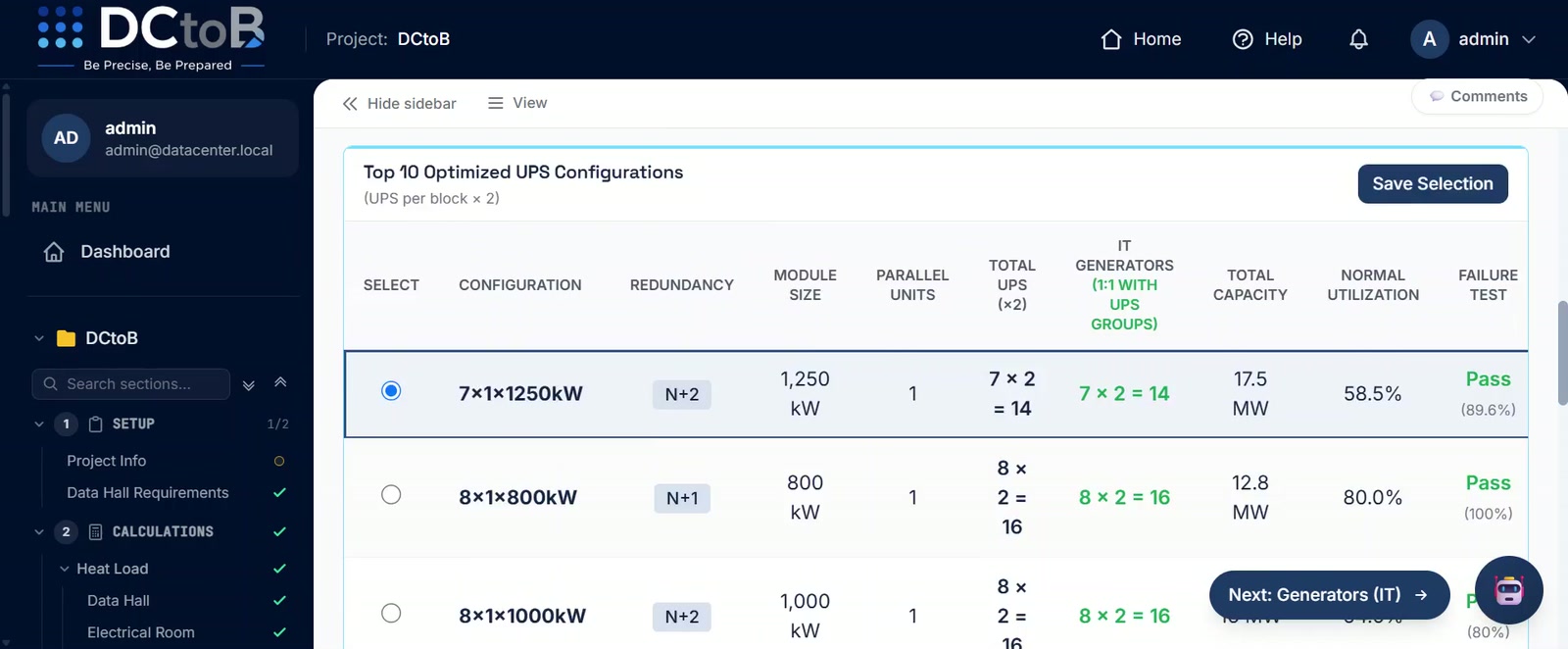
UPS
Modules, parallel sets and redundancy matched to the IT load and tier target, including distributed-redundant schemes.
Generators
Standby generators for the IT load alone, or for IT and cooling together, sized per block with redundancy.
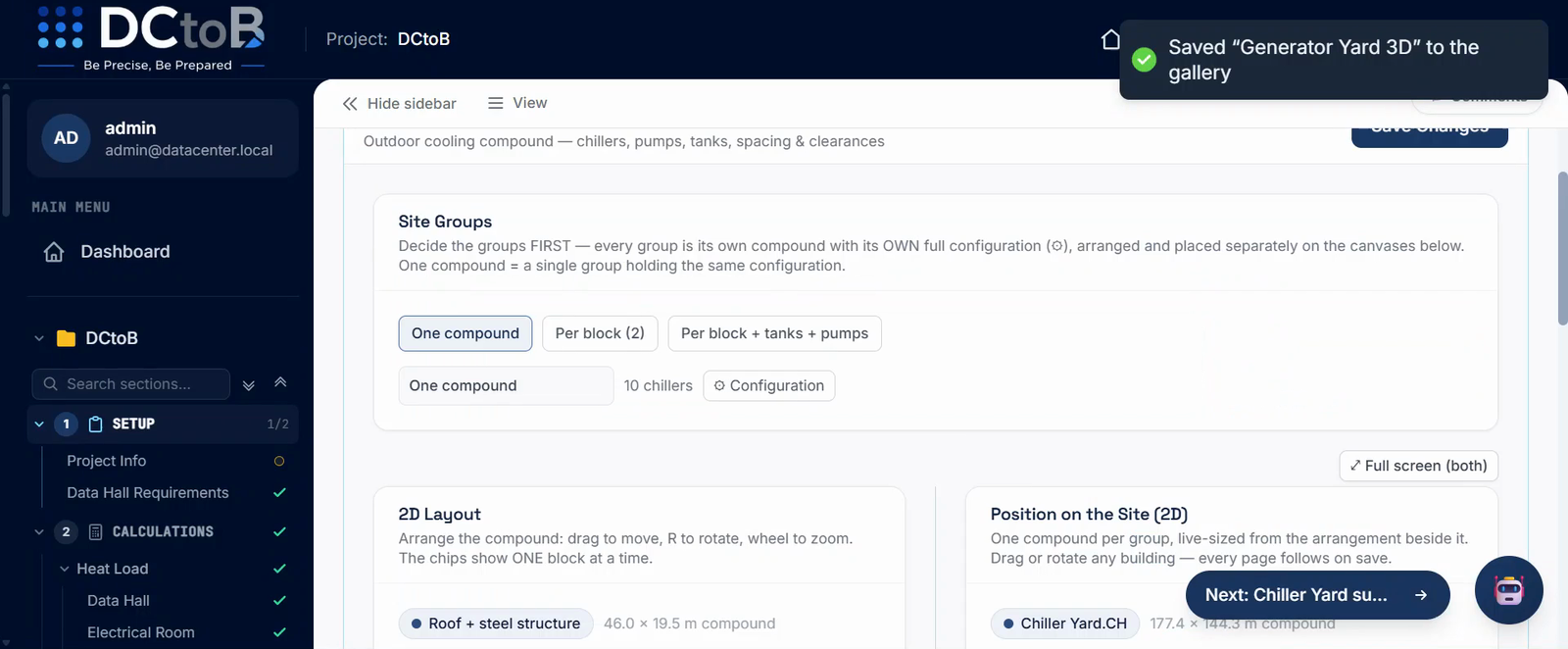
Chillers & pumps
Chiller and pump selection from the heat load, with the heat-load and flow calculations behind them.
Hydronic loop
Expansion, buffer and make-up vessels sized with the rest of the cooling plant.
Cooling units
CRAHs for air-cooled halls and CDUs for liquid-cooled halls, sized hall by hall.
Mechanical UPS
Continuity power for pumps and cooling units, so cooling rides through the transfer to generators.
Sizing to redundancy, not just to load
Capacity is only half of the answer. The same IT load needs very different equipment depending on whether the target is N+1 or 2N, and whether redundancy is provided by spare modules or by independent paths. DCtoB maps redundancy choices to the Uptime Institute Tier classifications, so N, N+1 and 2N are explicit and consistent across the UPS, generators and cooling plant. N, N+1, 2N and Tier levels explained.
Grounded in recognised standards and real equipment
- ASHRAE TC 9.9 — cooling is sized against ASHRAE allowable and recommended envelopes for inlet temperature and humidity.
- IEC / IEEE — transformer, generator, UPS and distribution sizing follow IEC/IEEE conventions for ratings and protection.
- Uptime Institute Tier I–IV — redundancy and topology targets map to Tier classifications.
- NFPA 70 / 75 / 76 and TIA-942 — power, spacing, life-safety and infrastructure classes.
Equipment is specified and costed from leading vendors — Schneider Electric, Vertiv, Delta, ABB, Eaton, Siemens, Cummins and Caterpillar — and the sized plant flows straight into the single line diagrams and the bill of quantities.