
What changes when racks go high-density
Conventional enterprise racks draw a few kilowatts each. AI training racks commonly draw tens of kilowatts, and the newest GPU systems can exceed 100 kW per rack. At those densities the building is shaped by power delivery and heat rejection rather than by floor area — a hall can run out of cooling long before it runs out of space.
- Cooling moves to liquid. Air alone struggles at high density; direct-to-chip liquid cooling through coolant distribution units (CDUs) carries most of the heat, with air handling the rest.
- Power per hall climbs. Feeders, UPS and switchgear scale with the load — and so do the generator and cooling plants behind them.
- Densities mix. Few campuses are AI-only; most combine high-density halls with conventional ones.
Planning mixed densities, hall by hall
In DCtoB each hall carries its own rack mix and density, so an AI hall and an enterprise hall can sit on the same campus with their own loads. Electrical feeds are sized to each group of racks' actual load rather than to the worst case everywhere, which keeps the power chain proportionate to what it really serves. The effect on equipment is explained in power and cooling sizing.
Liquid and air cooling in one plant
Liquid-cooled halls are served by CDUs and air-cooled halls by CRAHs, and the chiller plant can be common to both or dedicated to each — sized from the actual heat load, including the hydronic loop and its vessels. Cooling continuity is sized alongside: a mechanical UPS keeps pumps and cooling units running through the transfer to generator power.
Redundancy at high density
At high density, a cooling or power interruption reaches the IT equipment faster, which makes redundancy decisions weigh more. Test them before committing: trip a UPS, generator or feeder and see how the load re-routes. How the redundancy test works.
From concept to budget
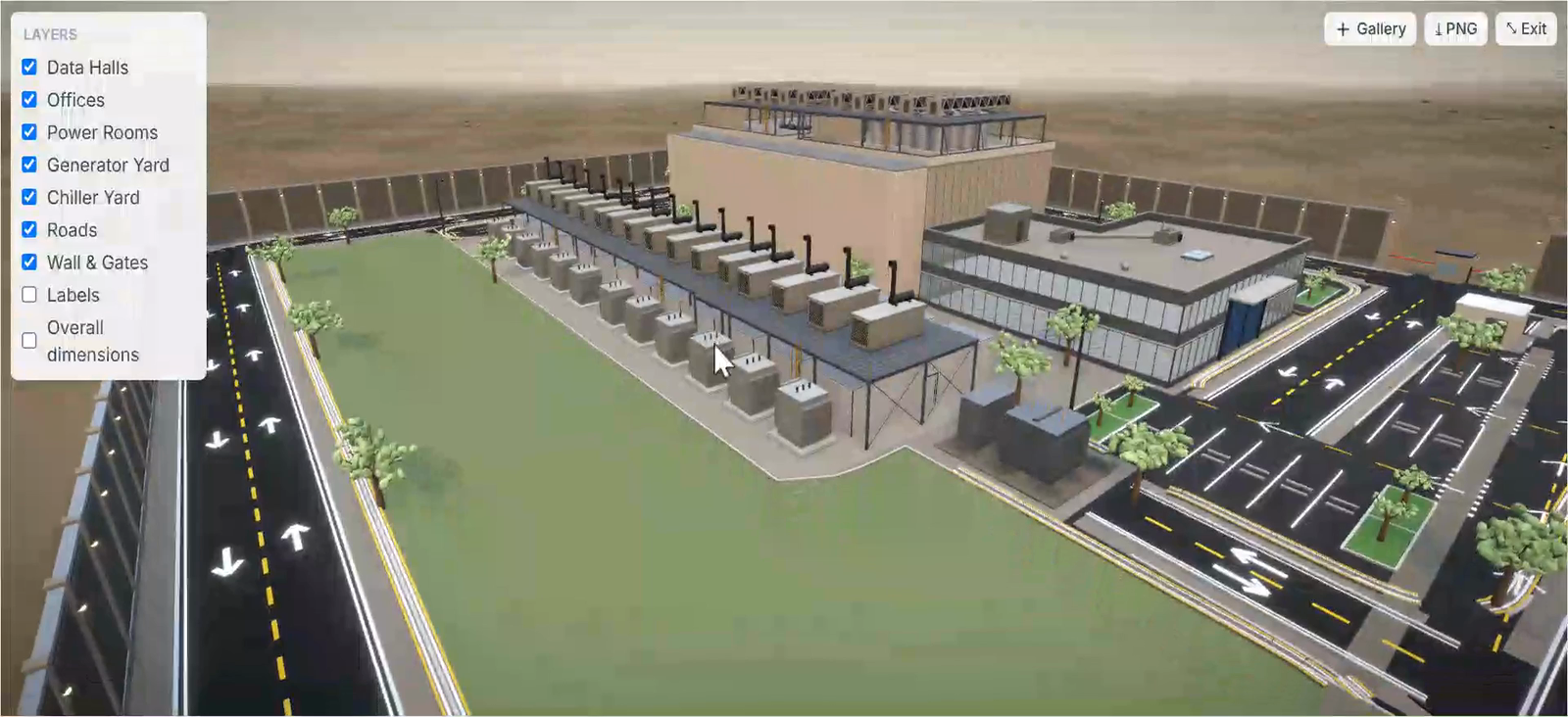
The same model produces the single line diagrams, the site layout and the priced bill of quantities — so a high-density concept reaches the budget conversation with its real power and cooling plant attached.